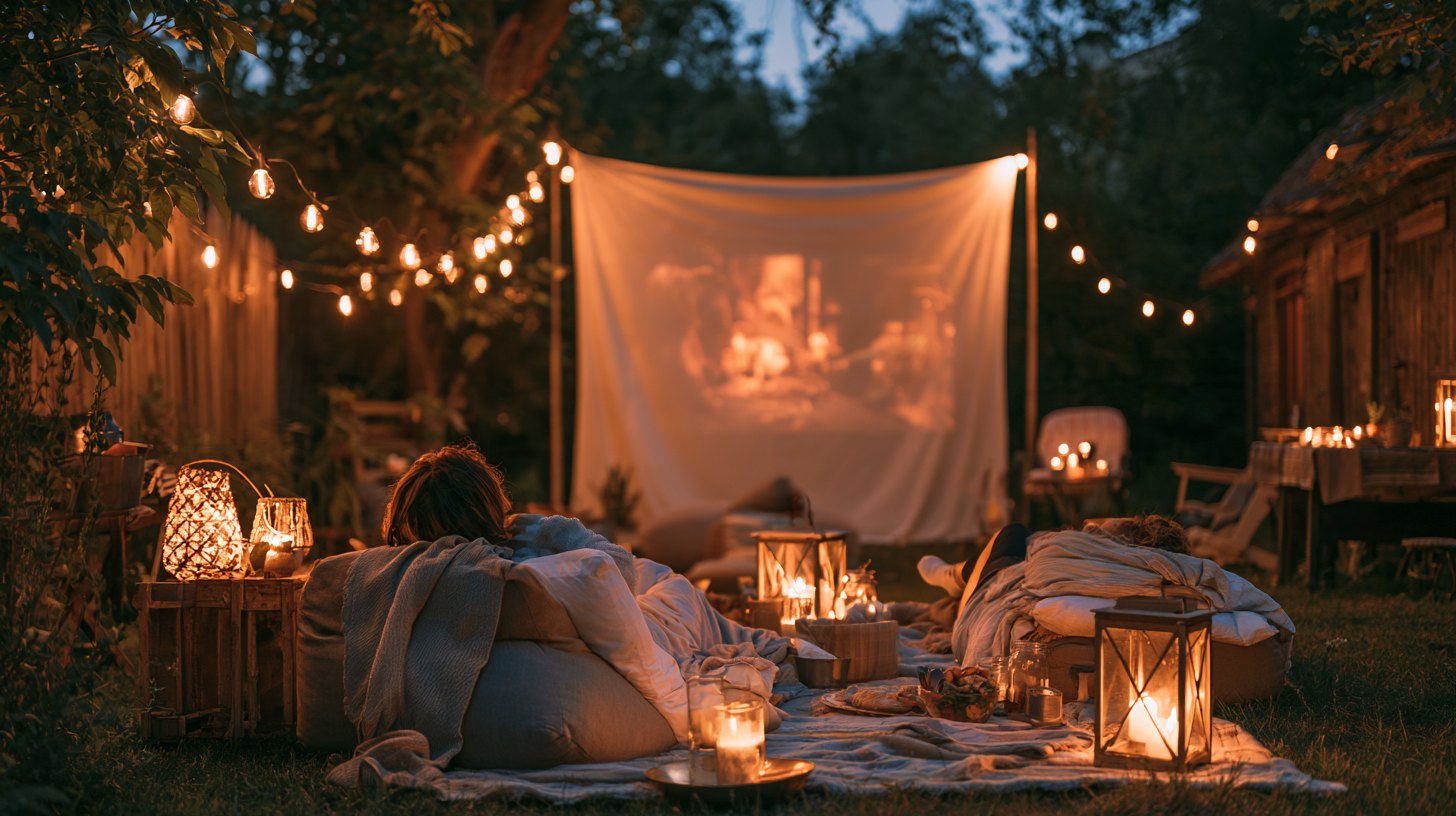
A backyard movie night done right is one of the better ways to spend a summer evening. Done halfway, it is a dim image nobody can hear, a phone hotspot that drops mid-film, and neighbors asking you to turn it down. The difference comes down to a handful of decisions you can make before sundown.
Screen size and throw distance
Start with the screen, because everything else scales from it. For a group of eight to twelve people sitting in rows, a 120-inch diagonal screen (roughly 10.5 feet wide by 6 feet tall for 16:9) is the right target. Anything under 100 inches looks like a TV someone dragged outside. Most portable projectors rated for outdoor use need at least 10 feet of throw distance to hit 120 inches; check the throw ratio on the spec sheet and measure your yard before you buy. A 1.2:1 throw ratio projector needs about 12.5 feet from lens to screen for that size. Short-throw units work in tighter yards but cost more.
Mount the screen between eight and twelve feet off the ground at its base so people in back rows are not looking over heads. If you are using a standalone inflatable or frame screen, stake it firmly — even a light breeze moves an unstabilized screen enough to ruin the image.
Projector brightness and ambient light
Outdoor projection is a brightness problem. You need at minimum 3,000 ANSI lumens to get a watchable image at dusk; 4,000 or more if you cannot start until the sky is fully dark and neighbors have lights on. Do not trust "LED lumen" figures printed on cheap units — those numbers are not comparable to ANSI lumens. Look for projectors that explicitly state ANSI lumens on the spec sheet. Plan your start time for 30 minutes after local sunset so the sky is actually dark.
Sound
Projector speakers are useless outside. Sound dissipates fast in open air, and any wind kills it entirely. A Bluetooth speaker rated at 60 watts or more pointed toward the audience works for groups under fifteen. For larger gatherings, a pair of powered PA speakers on stands — positioned just outside the screen frame, angled inward — gives you even coverage without one side of the yard being louder than the other. Keep the volume at a level where someone fifteen feet out can still hold a conversation. Your neighbors will thank you and so will the people in the front row whose ears are closest to the speakers.
Seating, lighting, and power
Mix seating types: a few rows of folding chairs for people who want the straight-on experience, a blanket zone in front for kids, and some camp chairs or low loungers on the sides for people who will be talking. Leave a path down the middle so people can get up without climbing over anyone. Run a single string of warm-white café lights around the perimeter at low level — enough to navigate to the drink cooler without killing night vision. Kill all other yard lights and make sure your house's motion sensor lights are temporarily disabled or they will blow out the image every time someone moves.
Power is the practical constraint most people underestimate. A projector, a speaker, and a streaming device together can pull 400 to 600 watts. A single 100-foot outdoor extension cord rated for 15 amps handles that fine, but do not daisy-chain two or three household cords — that is a fire hazard and a voltage drop problem. If your nearest outlet is more than 100 feet away, a portable power station in the 1,000Wh range gives you a clean, safe solution for a two-hour film.
The content problem
Once the hardware is sorted, the real friction shows up: what you want to watch is scattered across four or five services, each billing you monthly, and the libraries keep shrinking as rights deals move around. You plan a screening of a film you remember being on one platform and it has quietly moved or been removed. That is not a hardware problem you can solve with a better cable. One way people handle this is by consolidating access through a single subscription that covers a broad library without juggling individual apps — an IPTV subscription service like OveloTV gives you one login, one monthly cost, and a library wide enough that you are not hitting dead ends the night of your screening.
Choosing what to watch for a group
Apply three filters in order. First, runtime: anything over two hours and fifteen minutes is a hard sell outdoors where people get cold, need bathroom breaks, and have to drive home. Second, audio mix: films that rely heavily on quiet dialogue suffer most from outdoor sound conditions — action, comedy, and animation hold up better. Third, crowd familiarity: a rewatch everyone already loves beats a first-time screening of something polarizing. If you still cannot decide, put three options in a poll on your phone and let the group vote in two minutes. Do not overthink it.
What the evening feels like when it works
When the setup is right — image sharp, sound even, seats comfortable, lighting dim but not dark — the backyard disappears. People stop looking at their phones. Conversations between strangers happen naturally during the pauses before the film starts. The sky above the screen is actual sky, which no living room can replicate. It is worth the setup time, but only if you do it properly. A mediocre setup teaches people not to come next time.
If you want to run these nights regularly without the content logistics eating into the experience, it makes sense to have reliable, consistent access to a large library. OveloTV's IPTV plans are built for exactly that kind of use — one subscription, broad coverage, no guessing which platform holds the rights this month.
Frequently asked questions
What size projector screen should I use for a backyard movie night?
For groups of eight to fifteen people, a 120-inch diagonal screen is the practical standard. Below 100 inches feels small in an open yard. Make sure your projector's throw distance matches the screen size before you commit to either purchase.
How many lumens do I need for an outdoor projector?
At minimum 3,000 ANSI lumens, and ideally 4,000 or more. Start the film after full dark. "LED lumens" figures on budget projectors are not the same measurement and will mislead you.
Can I use my regular Wi-Fi outside for streaming?
If your router is within 50 feet and there are no thick walls between you and the yard, it may work. Beyond that, a mesh extender node placed near a window or a wired connection to an outdoor access point is more reliable than hoping your signal reaches. Buffering mid-film in front of guests is not a situation you want.
What is the easiest way to handle content across multiple streaming services?
Consolidating into a single broad-access subscription removes most of the friction. Rather than managing four or five separate apps and billing dates, a service like OveloTV gives you one interface and consistent access to a wide library, which matters most when you are planning a specific screening and need to know the content will actually be there.