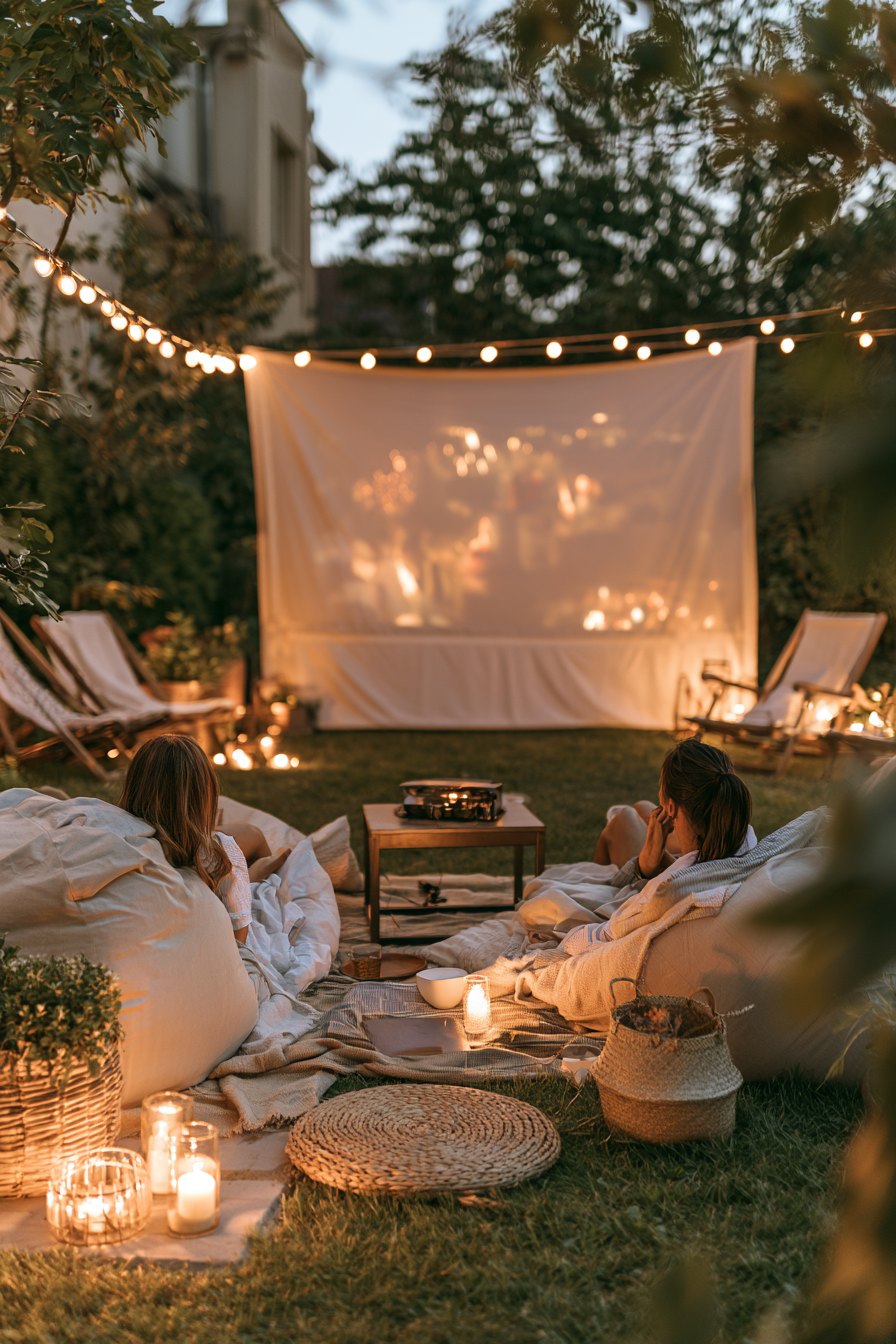
A small backyard is not a problem. It is a constraint, and constraints force better decisions. Most people who end up with a genuinely good outdoor setup have less space than they thought they needed. What kills the experience is not square footage—it is the wrong screen size, the wrong throw distance, ambient light that washes everything out, and sound that dies three feet from the speaker. Fix those four things and a 12-by-20-foot patio becomes a legitimate outdoor theater.
Screen size for a small yard: smaller than you think
The instinct is to go big. Resist it. In a backyard where your seating is only 10 to 15 feet from the screen, a 120-inch diagonal is the practical ceiling—and 100 inches is often the smarter call. Beyond that size, your projector has to work harder to fill the image, keystone distortion becomes a real issue at tight angles, and the edges of the picture start to blur for viewers sitting off-center. A 100-inch, 16:9 screen measures roughly 87 inches wide by 49 inches tall. That is a legitimate cinematic experience at 12 feet. You do not need more.
For throw distance, check your projector's throw ratio before you buy anything else. A standard projector with a 1.5:1 throw ratio needs about 12.5 feet of distance to fill a 100-inch screen. A short-throw model at 0.5:1 can do the same from roughly 4 feet—useful if your only flat wall is close to where people sit. Measure your actual usable depth, subtract two feet for the projector itself, and let that number drive your screen size, not the other way around.
Screen types: frame, inflatable, or DIY
Fixed-frame screens look the best and stay taut, but they live outside all season or have to be disassembled and stored every time. For a small yard where setup and takedown is a weekly ritual, a tensioned pull-up screen on a tripod stand is more realistic. They pack down to a carry bag and go up in under five minutes. Inflatable screens are genuinely fun but they require a blower running constantly, which adds noise and a power draw you may not have budgeted for.
The DIY option that holds up: a length of blackout cloth stapled or grommeted to a PVC pipe frame. Blackout cloth—the kind sold for photography, not window shades—has a gain of roughly 1.0, rejects ambient light reasonably well, and costs about $1.50 per square foot. A 100-inch screen surface costs you under $30 in material. The trade-off is setup time and the fact that you are building and maintaining it yourself. If that is fine, it is hard to beat on price.
Placement and ambient light: the two decisions that matter most
Outdoor projection only works in the dark—full stop. In a small yard, that means screening the screen from street lights, porch lights from neighbors, and any interior lights spilling through your own windows. Orient the screen so it faces away from the street. Position it against a fence or hedge if you can; the dark background behind viewers reduces eye fatigue and makes the image pop harder. Start your movie no earlier than 30 minutes after local sunset, and kill every light source within 20 feet of the screen.
String lights are the enemy of contrast. If you want them for atmosphere before the film, put them on a switch or smart plug and turn them off the moment you hit play. The mood you lose in ambient light is not worth the mood you gain in decoration.
Seating, sound, and power in a tight footprint
In a small backyard, seating rows eat space fast. One row of camp chairs or a low sectional placed 10 to 15 feet out works better than trying to stagger two rows in a space that cannot support it. Low seating—floor cushions, bean bags, a folded blanket—feels right outdoors and keeps sightlines clean for everyone. Leave at least four feet of walkway behind the projector so nobody trips over cables.
Sound is where most outdoor setups fail. Projector speakers are built for indoors at close range; outside, they disappear. A single Bluetooth speaker placed slightly behind the seating, angled toward the screen, will outperform the projector's built-in audio significantly. If you want stereo, two small speakers placed at screen level on either side of the frame is enough. Resist the urge to crank volume; neighbors exist.
Power: run one heavy-gauge extension cord from your nearest outdoor outlet to a small power strip near the projector. Do not daisy-chain lightweight cords. Most short-throw projectors draw 200 to 300 watts; add your speaker and you are well under a standard 15-amp circuit. One cord, one strip, taped flat across any walkway.
The content problem nobody talks about
You get the setup right and then you spend 25 minutes arguing about what to watch. This is not a personality flaw—it is a structural problem. The title you want is on one service, the other title is on a different one, a third service has the sports. Each charges separately, libraries rotate as licensing deals expire, and the total monthly bill for three or four services adds up fast. If you are setting up a regular outdoor movie night, that fragmentation is real friction. One option worth knowing about is a consolidated IPTV subscription that pulls a wide library into a single access point rather than requiring you to manage five separate apps and five separate bills.
What a good evening actually feels like
When the setup is dialed in—screen tight and flat, projector focused, speakers placed right, every stray light source killed—the experience is genuinely different from watching inside. There is something about the open air, the slight temperature drop after sunset, and the scale of the image that makes even a film you have seen before feel worth the effort. People settle in differently. Conversations stop at the right moment. The yard, which might be your most underused square footage, becomes the place everyone wants to be.
Getting there consistently requires removing friction from both the physical setup and the content side. For the content side, browsing a broad-catalog streaming subscription before the evening starts—rather than hopping between apps mid-argument—is a practical move that saves more time than any equipment upgrade.
Frequently asked questions
What is the minimum backyard size for an outdoor projector setup?
You need enough depth for your throw distance plus seating. With a short-throw projector, you can work in a space as shallow as 12 to 14 feet total—about 4 feet for the projector, 8 to 10 feet for seating. Width-wise, a 100-inch screen is just under 8 feet wide, so a 10-foot-wide space is the minimum that does not feel cramped.
Do I need a special outdoor projector or will any projector work?
Any projector works outdoors in dry weather, but brightness matters more outside than inside. Look for at least 2,500 ANSI lumens for reasonable image quality at dusk; 3,500 or more gives you more flexibility. If you plan to leave the projector outside between uses, you need one rated for outdoor or weather-resistant conditions—otherwise, bring it in after every screening.
How do I deal with insects flying into the projector beam?
They will. Bugs are drawn to light, and a projector beam is a lot of light. Citronella candles and bug zappers placed away from the seating area help at the margins, but the honest answer is that some insects on the screen is just part of outdoor projection. Keeping the surrounding area dark—no garden lights, no porch lights—reduces the overall insect draw.
Can I mount the screen permanently on a fence?
Yes, and it is a good solution for a small yard. A fixed blackout cloth screen grommeted and tied to a wooden fence eliminates setup time entirely. The trade-off is UV degradation over a full season outdoors; expect to replace the cloth every two to three years depending on your climate and how much direct sun the fence receives.
Where do I find a wide content library without paying for multiple streaming services?
The fragmentation problem is real, and most households are paying for more services than they actively use. An IPTV subscription is one route that consolidates access to a large content catalog under a single monthly cost, which is worth evaluating against what you are currently spending across separate platforms.