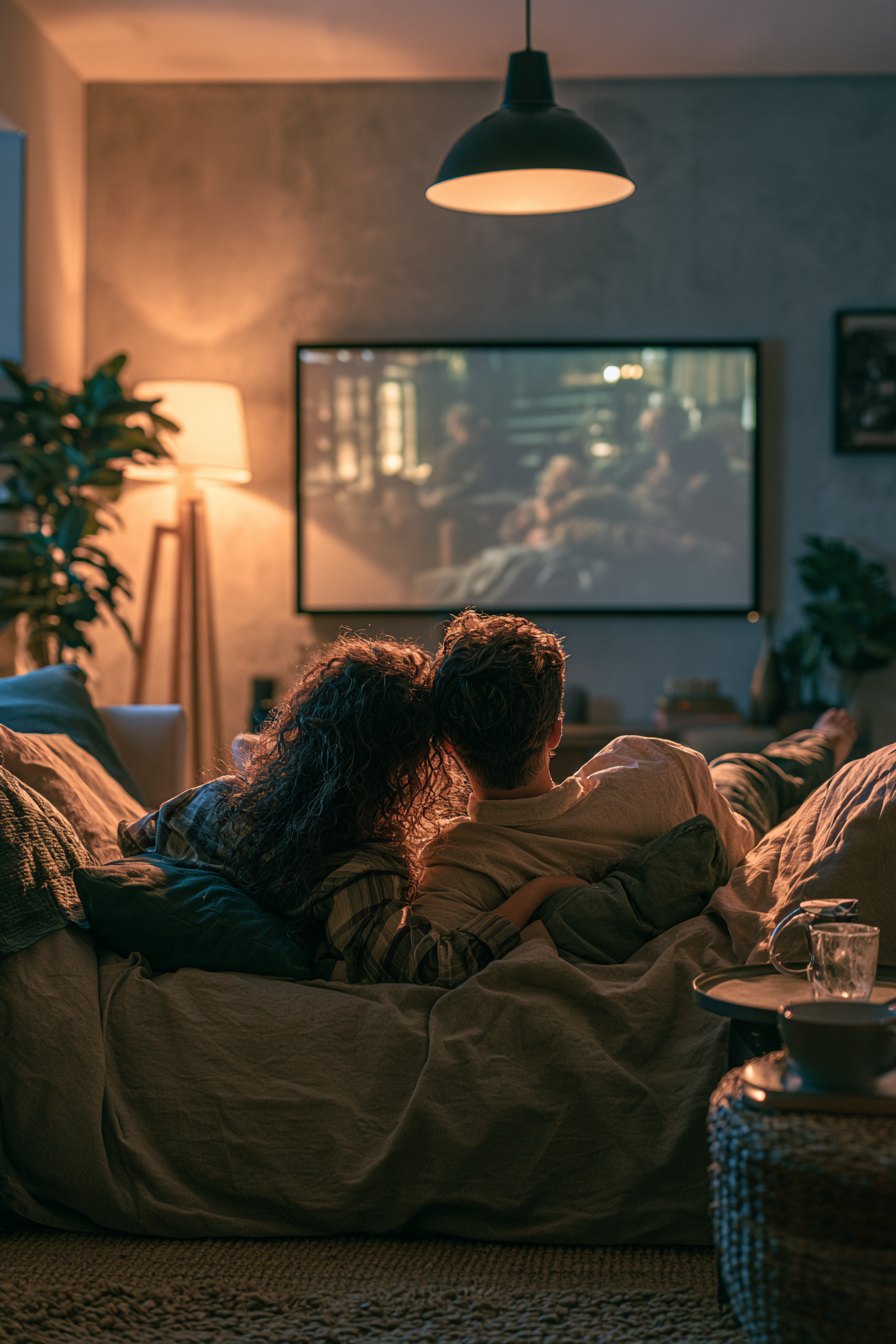
Most small-room home theater advice either assumes you have $3,000 to spend or treats you like you've never owned a TV before. This article does neither. If your living room is somewhere between 10×12 and 14×16 feet and you want a setup that genuinely feels cinematic without gutting your savings account, here's what actually matters and what you can skip.
Screen size: the one number people get wrong
The instinct in a small room is to go smaller so the image doesn't feel overwhelming. That instinct is wrong. A screen that's too small just looks like a TV. The Society of Motion Picture and Television Engineers recommends a horizontal viewing angle of at least 30 degrees for an immersive feel. In practical terms, if your seating distance is 8 feet, a 65-inch TV sits right at that threshold. At 10 feet, you want 75 inches. Yes, a 75-inch TV in a 12-foot-deep room feels big at first. After one movie, you stop noticing the size and start noticing how good it looks. Mount it at eye level when seated, roughly 42–48 inches from floor to center of screen, not above the fireplace where your neck will hate you after 90 minutes.
Projector vs. TV in a tight space
A short-throw projector can produce a 100-inch image from about 2 feet off the wall and costs $600–$900 for a decent 1080p model. The trade-off is brightness. In a room you can fully darken, a short-throw projector at 2,000–2,500 lumens looks stunning. In a room with windows you can't fully cover, a good 4K TV wins on contrast and color accuracy every time. Don't romanticize the projector if your room gets afternoon light you can't control.
Sound on a budget: skip the soundbar, consider this instead
A mid-range soundbar with a separate subwoofer in the $200–$350 range will outperform any TV speaker and genuinely change how action sequences feel. If you have a little more flexibility, a used 5.1 AV receiver paired with bookshelf speakers at the front and a small sub can be assembled for under $400 and will outperform a $700 soundbar. Place the sub in a front corner of the room, not hidden behind furniture. The low-frequency boundary effect in a corner actually reinforces bass output, which is useful when your room is small and you can't go loud at night.
Lighting makes or breaks everything
Bias lighting, a strip of LED light mounted behind the TV pointing at the wall, reduces eye strain, makes colors look punchier, and costs about $20–$40. Set it to a neutral white around 6500K. Overhead lights should be dimmable and positioned so they don't reflect off the screen. If you have recessed cans above the viewing area, a $15 smart dimmer switch is one of the highest-value upgrades in this entire setup.
Seating: the underrated variable
In a small room, a large sectional blocks sightlines and eats floor space. A loveseat or two chairs on a low-profile platform riser works better. The riser doesn't need to be more than 6–8 inches tall. Even that small elevation difference improves the viewing angle if someone sits in front. Bean bags are fine for kids. For adults watching a two-hour film, invest in something with lumbar support.
The content problem nobody wants to talk about
Here's where most home theater guides stop, and they shouldn't. You can dial in the perfect screen size, get the room dark, tune the subwoofer, and then spend 25 minutes flipping between apps looking for something to watch. The content is spread across five or six services, each billing you monthly, and the libraries shift constantly as licensing deals expire. If you want a broad, stable library without juggling subscriptions, it's worth looking at IPTV subscription services that consolidate live channels and on-demand content into one interface. The economics are straightforward compared to stacking individual streaming costs.
Putting it together: what a good evening actually feels like
When the room is right, you stop adjusting things. The image fills your field of vision without effort, the dialogue is clear even at low volume because the soundbar handles center-channel separation, and the bias lighting behind the TV keeps the room from feeling like a cave. You're not squinting or leaning forward. You're just watching. That's the goal, and it's achievable in a small room for well under $1,500 total if you prioritize screen size, one solid audio solution, and controlled lighting over everything else.
For content specifically, Ovelo TV is worth a direct look if you're tired of paying separately for every service and finding that what you want has rotated off the platform you just renewed. One subscription, one interface, a much shorter time between sitting down and actually watching something.
Frequently asked questions
What's the minimum room size for a home theater setup?
A 10×12 foot room is workable. You'll cap out around a 65-inch TV at a 7–8 foot seating distance, which still delivers a solid viewing angle. The bigger challenge in rooms that small is sound management, since bass frequencies build up in small spaces. A good subwoofer crossover setting around 80 Hz and corner placement helps keep the low end controlled rather than boomy.
Do I need 4K for a small room?
At 8 feet from a 65-inch screen, the human eye can resolve 4K detail, so yes, it matters. The more important factor is HDR support. A 4K TV with good HDR tone mapping will look dramatically better than a 1080p set in the same room, especially for films shot with high dynamic range in mind.
Is IPTV a legal option for home entertainment?
Legality depends on the specific service and the content it carries. Licensed IPTV providers who pay for distribution rights operate legally. It's the same question you'd ask about any subscription service. Research the provider before subscribing and make sure they operate with proper licensing agreements.
How do I reduce cable clutter in a small room?
Wall-mount the TV, run an in-wall cable management kit (around $25–$40 at hardware stores), and use a single HDMI switch or AV receiver as a central hub so only one cable runs to the TV. Fewer visible cables make a small room feel significantly larger.
The room doesn't need to be big to feel like a real home theater. It needs to be intentional. Get the geometry right, control the light, add real sound, and then solve the content side, which a single well-chosen subscription like the ones available at ovelotv.store can simplify considerably. Everything else is optional.